Thursday, 14 April 2011

Research Proposal - Using lighting to change our behaviour

During Semester One we were asked to read 'The Tipping Point' by Malcom Gladwell. We then had to choose one of the theory's in the book that we found the most interesting and research it further. I chose 'The Power of Context' looking at how humans interact with there surroundings, and the influence changing our surroundings can have on our behaviour. As this is a huge topic I decided to focus on a single aspect of our built environment, Lighting.


Through my initial research I learnt that lighting can be used to  influence our behaviour in many different ways. It can make us  feel safe and more secure in potentially dangerous  areas such as subway tunnels, or in public toilets bright coloured light can make us fearful and anxious, making us evacuate the space as soon as possible. Lighting's ability to  subconsciously direct us through spaces and keep us aware of our environment is what I will be investigating  in my research proposal. I want to find out how we could optimise a space for humans to get the maximum use out of it, using light. 


The research methods I will use will be experiment based, alongside observation and an interview to collect information.
A feasible location to carry out the experiment would be a university library, more specifically a study zone within a library where good  lighting is essential, and there are a large amount of people present and who use it frequently. I have noticed from my own experiences and from talking to others that have used a study zone that it is very easy to become distracted, and/or begin people watching. I feel that the bright overhead lighting often found in these study zones may contribute to this distraction. Because we are seeing everything in bright light movements in the space can be easily picked up by our peripheral vision. These movements could be anything, even someone bobbing there head to music is enough to distract some people. 

The experiment I propose to carry out will help me to gather information on levels of distraction within the library setting and see how much of it is linked to having the brighter lights. 
In preparation for this I would look to take a small section of the study zone and slightly dim the overhead lighting in that area, If there was no dimming option for the lighting, I would look to place a suitable dulling material over the lights. I would then equip all the study desks in the area with there own personal lamps.
 I will then observe and note the distraction levels of students, first with the library lights at there normal strength, and then again after dulling the lights.(Possibly on a different day) The distractions I would be looking for would be things that could be seen in bright light, but not when the light is dimmed.


Alongside my observations, I would ask a small selection of students to spend some time studying in the library when the lights were at there usual level of brightness, and again when I had dimmed them, I would then carry out a quick semi-structured  interview with them, questioning how well they felt there studying went at both periods. 
I would include questions like:

In which of your study sessions did you feel the most focused ?


In which study session were you the most productive?


Did you find  working in a dimmer light had any negative aspects?


Did you find working in bright light has any negative aspects?


What level of lighting would you like to prefer to use in the future?


Using both an interview and observing/recording, would allow me to gather a broader selection of information to work with.
Observation would allow me to record the causes of the students distractions, and determine weather they would still be apparent in weaker light conditions. This would then give me an overall impression from which I could take a general conclusion. The interviews will allow me to gather more in depth information, adopting a semi - structured approach and leaving questions open would allow students to elaborate on there answers, providing useful personal  information about there studying  experience during the experiment.
I would look to carry out the experiment over a couple of days, recording for a few hours at a time, during different times of the day this would give me wide enough selection of students and changing  light conditions to draw a general conclusion. I would ask for another person to help observe from a different position as this would allow a wider area to be covered, and provide more even results.


Working through the design process ,the information  gathered from this experiment would hopefully provide a building block to work from and ideas could then start to be formed about potential solutions.One possible solution  could be designing the lighting  in a way to allow for safe navigation of the space, but subtle enough to not illuminate everything, then individual task lights would illuminate only the area that the student was working on.(similar to the individual task lights on an aeroplane)


Tuesday, 12 April 2011

Assignment 4 - How much of an affect does lighting have on the way we experience a space?

I have decided to look at lighting again for this assignment, and research how much of an effect it has on us in certain environments. I will be taking a different approach to my research this time, as we have been asked to prepare and carry out an interview with a small number of people.

-Preparing the interview questions.

In order to find out what questions I wanted to ask I  started a mind map looking at lighting in different situations, and what effect it has within these situations. For example; Lighting in a cinema lobby is usually dimmed to create a more intimate atmosphere and prepare users for the low light of the cinema, but if  it wasnt dimmed, users may find the transition between a brightly lit lobby and a dark cinema room more tricky, as I would take there eyes longer to adjust.


It is the quality of the information rather than the quantity that will be useful to me, so the questions I ask will have to be open, allowing for a variety of answers and prevent people from answering with yes/no.

Here are the questions I created.

Q.1 What are the factors that influence you the most when you first walk into a room/space ?
 Q.1b Can you list them in order of importance?

Q.2 What would you personally use to create a specific atmosphere in a space?
Q.2b Which of these elements would you consider the most important?

Q.3 Do you feel that spaces should be lit differently for different purposes?
       If yes, why?

Q.4 Have you ever been in a space where you found the lighting uncomfortable?

Q.5 Apart from reading any reviews or reccomendations, what would influence you to choose one Restauraunt over another?

When carrying out the interviews I used a semi-structured approach, using the questions I had prepeared, but also elaborating  on them in order to gain more information from the person being interviewed.


Here is a condensed version of a couple interview results.

Person 1
Name:    SuzieWilliams
Age:       43
Gender:  Female

Q1. Answer
Big windows, Colours, Light, Ventilation
 Q.1b Light/Big windows,Ventilation, Colours

Q.2 Answer
Plants, Lighting Music
Q.2b Lighting, Music, Plants

Q,3 Answer
Yes, Important to set the mood of the room

Q4, Answer
Yes, many times at librarys, supermarkets and some restaurants where "it was hard to see the food."

Q.5 Answer
Noise, external appearance, internal lighting scheme.

Person 2
Name:    Steve Evans
Age:       38
Gender:  Male

Q1. Answer
Overall atmosphere created by lighting and music, Layout, Decor
 Q.1b Overall atmosphere, Layout, Decor

Q.2 Answer
Warmth, decor/objects, lighting
Q.2b Lighting, Warmth, decor/objects


Q,3 Answer
Yes, "Because I like to create different feelings in a room to work in or to chill out."

Q4, Answer
Yes, Restraunts that are too bright "hate strip lighting in supermarkets, makes me leave quicker"

Q.5 Answer
Real fireplace inside restraunt, relaxed lighting and atmosphere

 From looking at my interview results, the way a space is lit seems to have a large impact on how people feel about it. The strip lighting in supermarkets and other public spaces can put people off, and force them to leave yet a soft mood light seen from outside a restaurant can draw people in. Light also is a tool people seem to  use readily when they are looking to create a specific atmosphere in a room.


Monday, 21 March 2011

Fish out of water.

Our next design Studies assignment is looking at ethnography and design, and how combining them can create innovative, highly specialised and meaningful design solutions.

Ethnography is a research method that looks at the behaviour of humans in there natural environment, behaving as if no one was analysing them. This allows researchers to analyse, process and deliver meaningful information that lets us break out of our own bubble of preconceived ideas and have a look at how others do things.

Breaking out of the bubble is a must.


The information and ideas collected by ethnographers can then be used by designers of any discipline to solve problems that might have otherwise been over looked.
To allow us to begin to understand how powerful ethnography can be we have been asked to get ourselves into an environment that we are not used to and feel uncomfortable in. We must then act as ethnographers, becoming aware of the people around us, observing any unspoken rules and changes in behaviour.

Fish, but no water.


The location I chose to carry out this research  was the London  Underground Transport system, I have had no previous experience on the underground so this was a great opportunity to observe the way I felt when I was underground, using it.

Some of the main observations I made after my first journey where,

  •  SILENCE - There was almost complete silence on the carriage I was in, apart from a small group of kids who seemed to know each other. This could be because it was early in the morning, when the majority of people are still a bit groggy and seem to chat less, and the quieter  it is the less confidence people have to start up a conversation, as everyone else without ipods would  be forced to listen.
  • EYE CONTACT - People seemed to be avoiding eye contact  at all costs, peoples eyes were constantly darting around, or fixed on a paper or personal entertainment system.
  • COMPETITION - Getting onto the carriage at busy times seemed to be a bit brutal, people would push, shove and occasionally stab to make sure they get on before the doors close, the doors closing on me is probably what I feared the most while using the tube, mainly because It looked sore, but also because of the embarrassment it would cause.

  • LIGHTING - I find the lighting in allot of public places starts to hurt my eyes after a while, but the bright white lights on the tube where especially bad for me. I also found it very intense, and to be in a brightly lit enclosed space full of people for over 10 minutes seemed to become quite stressful. 


Maybe the lighting on the tube could look like this instead?

Rainbow Tunnel In Tel Aviv


Wednesday, 16 March 2011

Flexible Fabric Light Panels

Crushable, foldable and lightweight, electroluminescent technology can be woven into fabrics to create an illuminated surface when a voltage is applied to it.


The research into the technology is being funded by the military, hoping to get rid of heavier, breakable bulbs and speed up troop logistics. Other applications of this new technology could include
light up,fold away maps,
light up canvas panels in tents.
Safety clothing.


Working this technology into my current Interior Project, designing a transportable office space,  could create an interesting solution to the lighting systems within the space.

Monday, 21 February 2011

Eco Project - Inflatable spaces

During my research into temporary interior spaces I came across a company called 'Inflate' who offers a range of lightweight and portable structures for interiors as well as exteriors.

 INFLATE 

The small office or meeting spaces that inflate have managed to create with there OIAB product (office in a bag) have inspired me to do something similar with my project. Here are some images of the OIAB.

Interior


Cluster of OIAB's


Not an OIAB, but similar idea.


Experimentation with Inflatables


 Early experimentation with inflatables


Using the Inflatables seems to be a good solution, for the office spaces I will be designing, but they will have to be woven in and around a much stronger temporary structure that will provide a second floor.


To create this 'skeleton' structure, I have been looking at some innovative Eco friendly materials.

Cardboard is one of them.


The strength in cardboard can be seen in this structure (image on left), its 100% re-cyleable and can be weather treated, making it a serious option for my design.
Im going to research further into its properties to see how it is manufactured and what shapes and forms it comes in.


This reinforced cardboard could be used to create the struts in a geodesic dome, providing the framework for the temporary cladding, which could be similar to the products that Inflate has created (above).

I recently came across this site that explains how to create a simple geodesic dome using thin metal tubing. Im going to build one to get to grips with the structure.


Sunday, 20 February 2011

Polysemy

Polysemy means to derive a meaning.When we look at an image the meaning  it has will be different for each of us, and what the image induces will be based on our previous life experiences. Once  we focus on one meaning, many more sub meanings follow, allowing for many different interpretations of the original image.
Once text is added to the image, it reduces the wide range of meanings that could have otherwise been drawn from the image. Forcing you to make a connection between the text and the image.

To test this out I created a series of random shapes with a marker pen and then showed them to some friends to see what they could relate the shapes too.

Here was the most successful scribbling.


4 out of the 7 friends I asked likened the shape to some sort of flying object, and 2 of those 4 said a helicopter.
In order for me too get a higher percentage of people seeing it as a helicopter I added some 'swoosh'
marks commonly used in cartoons to suggest rapid movement.

The thinner swoosh marks I added worked a little, and a few more people thought it was a helicopter
I then  added some text to help lock in the meaning of the scribble:

Thursday, 3 February 2011

Eco Project - Transportable office space.


  • BRIEF :  Design an innovative and dynamic urban hub for SEPA - Environmental protection agency.

  • SITE :   We have been given the architectural shell of an existing warehouse in Dundee previously  used by DC painters and joiners.


We have been given a breakdown of what basic accommodation or zones we need to provide for our client, as well as  a general guide to the size of each zone, eg. Reception, offices, communal area. However how we decide to organize the interior space in relation to each person's space and zone requirements can be radically different from a conventional office.

I have decided to work with a partner for this project as we both share a similar vision of what we want to do, which is:

Create a transportable adaptable office and learning  space that can exist indoors or outdoors, and can accommodate a variety of events, number of people and objects. 

Initial research begins..

Buckminster Fuller


Snoop.


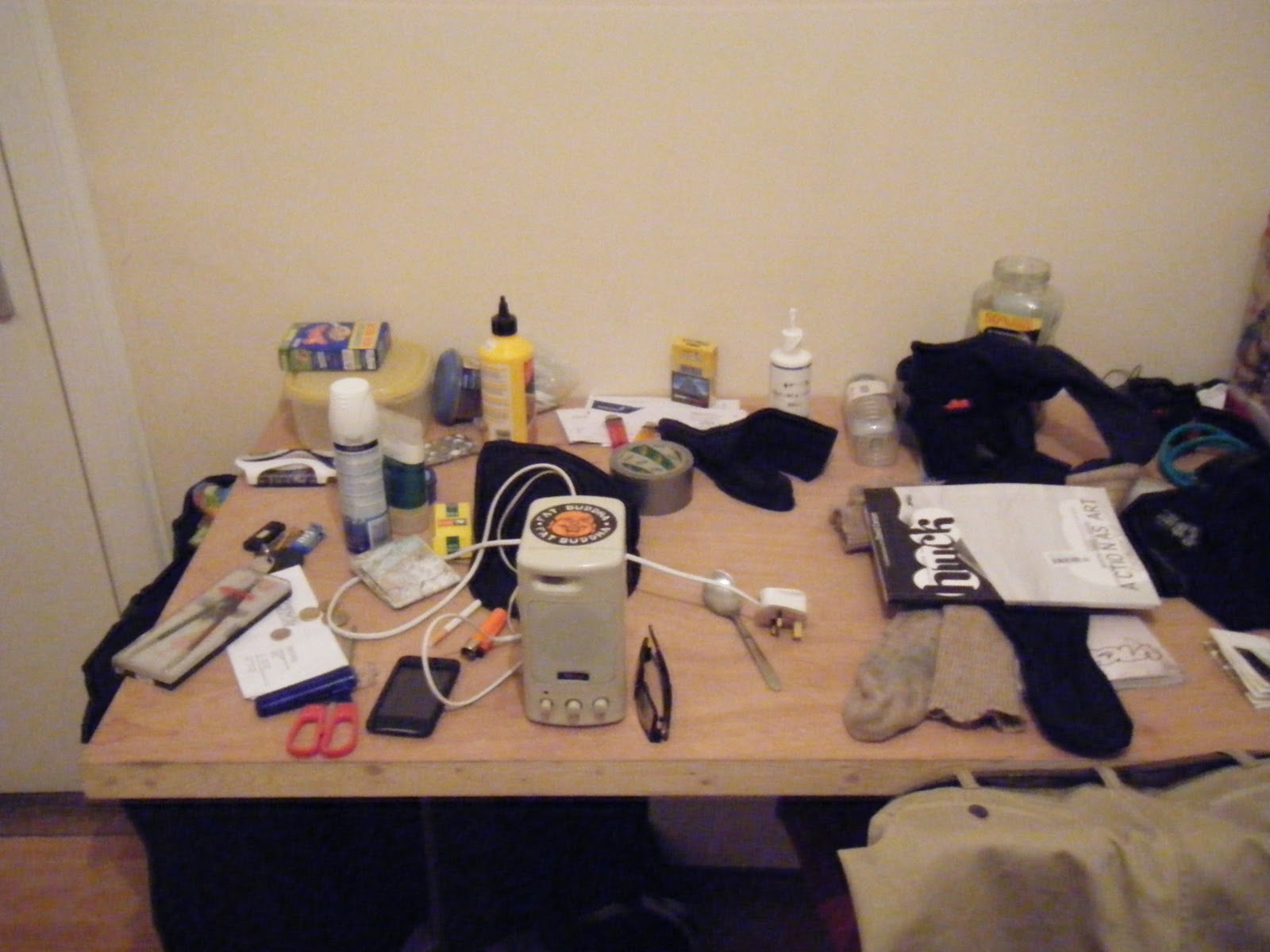
For this assignment we have been asked to try out 'snooping' with the possibility to become a 'super snooper' by examining another persons personal space and belongings to collect information that will help us determine certain aspects of there personality, this will then help us to look at ourselfs and identify what makes up our own personal style.

Carrying out this assignment required us to swap photos of our childhood with another student from a different disapline.

These photos had to be relaxed and show ourselfs amoungst our personal belongings, or spaces we use on a daily basis, not really thinking too much about how we organise them.

Here are the images that I received.

 View of shelf,  close up of shelf.


Looking at these images I can start to anaylise the items and there placement in the room. The room definately looks like it is part of a student flat, with minimal permanent decorations, or too many objects from the students past, suggesting that he is quite independant.

There is a large number of graphic design books on a temporary shelf which indicates that the student may be quite established in the course already.

 Close up of Cuboard and bed.


The clothes are fairly organized, suggesting that appearance is of reasonable importance.
Sleeping bag on bed  suggesting that comfort may not be of great importance.

After meeting up with sean to have a chat and discuss  our reactions to the images we sent each other, we both found out that our descriptions were fairly accurate.

So snooping works if you want to do it.


Sand Dune Architecture

Swedish architect Magnus Larsson, and been working on and developing a simple idea that could prevent desertification, and improve the quality of life for those living in dry areas.
He has chose to focus on an area in Africa named the 'Sahel' currently dealing with the problem of desertification.


The Sahel is a strip of land that lies on the edge of the Sahara desert, stretching across the entire continent.
Larsson proposes to create a vast sandstone 'habitiable wall' spanning the entire width of the Sahel.
He wants to do this by using a type of natural bacteria found in marches and wetlands, which when added to sand will bind it together forming sandstone.
This bacteria can then be injected into the sand dunes, and left for 24 hours to harden. The spaces created by the bacteria can then be excavated by natural forces such as the wind blowing onto the site and carrying the loose sand away with it.
The image below shows how Larsson Proposes to inject the bacteria into the dune.


These structures will create habitable spaces that can support the growth of trees, allow for condensation to be harvested and for desert community's to thrive.
Below are some conceptual images of what these sandstone structures may look like.


Wednesday, 15 December 2010

Furniture Project.

Furniture project- Final outcome.

Lighting, and its effects on human behaviour.

Design Studies Assignment 4

Source 1- Lighting: Its affects on people and spaces.

This article looks at  the subject of lighting in design. The author, Delores Ginthner
breaks it down into a few key sections; explaining how lighting design is accomplished, giving us some situational examples and criteria to evaluate lighting, as well as how to manipulate lighting to create a desired atmosphere or impression.
She explains that for lighting design, we must go through a design process used by most designers, thinking in layers. Using layers becomes of particular use in the schematic phase of the design process where different areas of lighting design may take priority over others, these areas can be broken down into;

 -Visual Task
 -General Lighting/ Ambient lighting
 -Visual Interest.

 An example she gives us compares the lighting within a restaurant, to the lighting of a Hospital operation room, the restaurant will be more concerned with general Lighting and creating a certain ambience, whereas the hospital  will need to be illuminated in a way that allows the staff to have a clear view of what they are working on. The designer/architect of  the restaurant will still have to think about task lighting to allow people to circulate safely, but this may not be the priority .In the same way, lighting in the operation room will primarily be functional, but the designer will have also thought about secondary lighting, to allow for tasks to be carried out that require less concentration, such as cleaning the room.


Ginthner also informs us on our psychological response to light and how it affects our behaviour and habits, lighting designers must carefully consider, what reaction they wish to provoke in the user as well as any specific atmosphere they they wish to create.
Ginthner  gives us a few examples, when it comes to navigating through a space we may struggle if there is not sufficient lighting where vertical meets horizontal, an example for this could be a hallway in a hospital, where if the light falling on the wall and floor where the same in value in hue, it would become a visual problem, making it hard for us to navigate easily.
Another example, taken from  a study by Taylor and Sucov (1974) is that when given a choice people will move towards light, acting like moths. Lighting designers may choose to illuminate a certain space more than others to draw people towards it.
Designers can also use this concept to focus attention on a particular object by increasing the contrast between the illuminated surface and the surfaces surrounding it. An example of this in practice can be seen in many bars and nightclubs, where either the bar, or the wall behind it is illuminated to create a contrast with its surroundings and pull people towards it.


As a lighting designer working towards creating a specific atmosphere, there are a few general guidelines we may choose to follow, Ginthner breaks these up in terms of the impression we wish to make;

-Pleasant
-Public
-Spacious
-Relaxed
-Visually Clear

She explains simple ways in which we can create these impressions, for instance a  pleasant atmosphere can be achieved by utilising more wall lighting as opposed to ceiling lights, as well as breaking up the lighting in the room. Public spaces on the other hand would require the opposite with a uniform distribution of light, and more ceiling lights.
Using these basic guidelines the designer can use lighting along side form to tailor a space towards its intended function whether it is a large brightly lit public space or a more subtle, enclosed private space.


Source 2 - Lighting, Colour and Human response.

In this book Faber Birren explores the world of colour and light.
He analyses the visual, emotional, psychic and biological effects that colour and light have on humans as well as animals and how we can use it to heal the body and calm the mind. For the purposes of my research I am going to focus mainly on his investigation into light, but will also touch on the subject of coloured light and how it effects us.
The first investigation on light, looks at how much light affects our growth and well being.

“Light is ubiquitous, it can be manipulated , and is not entirely benign”

 Above, Birren quotes Dr. Thomas R.C Sisson and  explains that visible light penetrates human and animal muscle and tissue, a lot deeper that previously thought. An example of this can be seen in the study Endocrinology (72:962, 1963) where researchers concluded that “environmental light can penetrate the mammalian skull in sufficient amount to activate photoelectric cells imbedded in the brain tissue”
Birren states that natural light is essential to us, if we wish to lead a normal healthy life. But just being exposed to light is not enough to maintain our health and well being, we need to be involved in the rhythms of light and dark.
If regulated exposure to light is not achieved, and either exposure to light or dark is prolonged, it may have strange effects on us. An example of this can be seen among Eskimo men and women, where lack of light will cause women to stop menstruating and will dramatically reduce the libido of men. As this effect is apparent not just in Eskimo men and women, but to anyone ,Birren concludes that lack of light can lead to a natural form of human hibernation.


It is a well known fact that colour can have  temporary psychological  and physiological  effects on us, the effects change as we move through the colour spectrum, these effects can be noticed;

 Red- will raise blood pressure, pulse rate, respiration, perspiration and excite brain waves.
Green - effects are more or less neutral
Blue - lower blood pressure ,pulse rate and perspiration and brainwaves start to decline.
Orange and yellow- similar to effects of red, but less pronounced.
Purple and violet- similar to blue.


Birren explains that our reactions to colour are quite similar to that of mild stimulants, such as coffee, alcohol or tobacco. we are up- stimulated and excited for a short period of time and then down again. For designers a functional use of colour could be to use a combination of colours to keep our responses alert. An example of this can be seen in mental institutes where a mixture of colour is used to keep patients responses active and to avoid emotional monotony.

Both of the sources I have used in this short investigation I have found very informative, The article written by Delores Ginthner gives us a basic overall view of how to create certain effects through lighting as well as giving us some examples of how to do achieve these effects. I feel this article is aimed towards the more conventional designer, who is wanting to use tried and tested methods to  replicate an atmosphere that already exists, such as that of a restaurant or Shopping mall.  My second source,  extracts from Faber Birrens book, analyses the subject of Light in more depth, drawing on research from a variety of different areas, giving us a much broader perspective on the subject, allowing the reader to come up with lighting ideas that may be more offbeat and unique.

Delores Ginthner. Lighting: Its affect on people and spaces. Implications. vol 2 (2), p1-p5.

Faber Birren (1978). Color and Human Response. Canada: John Wiley and sons. p20- P51.

Monday, 22 November 2010

Lighting, and its effects on human behaviour.

Assignment 3.
After exploring the main ideas of Malcom Gladwell's 'The Tipping Point' I chose to look at one of the theorys in the book that interested me the most,'The power of context'.
I started researching further into the idea of the power of context, and how humans relate to, and are affected by there surroundings, and found myself overwhelmed with the amount of  information received. So I decided to narrow it down to a more specific area that I have been interested in recently, lighting.


I began looking at the development of artificial light sources and how it has affected social and economic activity as we know it today.

Gerard W.Stoer, In The Light of the 20th Century, Licht/Light and design p.23-25.

Lucy Bullivant writes about lighting's ability to create our senses of security and awareness of our environment, as well as aiding communication between us.

Lucy Bullivant, Light Works, Licht/Light and Design p.105-118

Here Stanley explains that for good design to happen, we must think about all the possible ways a person may use a space and the lighting within it, and also the moods they may experience within the space.

Stanley Abercrombie, A.1990. A Philosophy Of Interior Design. First ed. New york: Harper and Row, pp111-124

This study looks at colour, and its effects on the mood and cognitive performance of 250 participants,
recording there reactions to different colours painted on the walls of a cafe.

Yildirim.K, Akalin-Baskaya. A, Hidayetoglu,M.L. 2006, Effects of indoor color on mood and cognitive performance(e-Journal) 42(9)Available Through: SciVerse Database. (Accessed 20 Nov 2010)

Sunday, 14 November 2010

Furniture Project - Smashing Pallets

Moving forward with our furniture project , I  have recently been breaking up some pallets with my team.
This will give us a better idea on how the pallets are constructed, and make it easier for us to break them down to work with.
Here are the tools we used for the job.


and here is some evidence of the destruction.


Monday, 8 November 2010

Collective Thinking

Brainstorming
We have been developing our brainstorming and mind mapping skills further, and using them collectively to explore new ideas in more depth.


Here we are brainstorming our individual subject areas that we studied for the last assignment, writing our thoughts down and posting them up as soon as they come to us.


When all the brainstorming was over, we began discussing a few chosen areas in more depth.


The poster below, was a visual representation of one of the areas of the book I chose to look at, the way that the advertising company, Lambesis portrayed Airwalk's shoes, to grow there business and launch them into the mainstream market.